Hablamos Español!
Modern Veterinary Diagnostics for Better Outcomes
Our diagnostic expertise identifies issues quickly and accurately so that we can provide the right treatment plan and return your pet to full health.
Diagnostic X-rays
We use digital x-ray to get the best look at what’s going on inside your pet, in particular their bones and muscles. X-rays can help diagnose issues such as arthritis, bone fractures, pneumonia, and more.
X-rays are non-invasive and safe, sedation is needed only in rare cases. They simply must be held still for a few minutes while the machine creates an image which can then be interpreted by our veterinary team.
Have questions or concerns? Contact us today about diagnostic x-ray imaging.
Advanced Veterinary Imaging
Veterinary Ultrasound is a non-invasive imaging technique that uses high-frequency sound waves to create images of the inside of an animals body. It is similar to the ultrasound technology used in human medicine but is specifically designed for use on animals. The images produced by the ultrasound can provide valuable information to help your veterinarian diagnose and monitor a variety of conditions.
Non-Invasive and Safe- One of the benefits of ultrasound technology is that it is noninvasive and safe for pets. Ultrasounds do not use radiation.
Advanced Imaging Capabilities- Our advanced veterinary ultrasound machine offers highresolution imaging, allowing for detailed and accurate diagnoses. This is particularly useful for identifying soft tissue abnormalities, such as tumors or cysts, that may not be visible on X-rays.
Versatility – Ultrasounds can be used for a wide range of applications, including abdominal, reproductive, and Point of Care imaging.
What You Can Expect:
- In-Clinic low-stress procedure.
- Your pet will stay with our veterinary care team for the day.
- Your pet will be monitored by our highly qualified veterinary technicians, for comfort and stability from drop off to pick up.
- Ultrasound can be performed with our Certified Sonographer RVT or with a mobile Board Certified Veterinary Imaging Specialist.
- All cases are reviewed by Board Certified Specialists.
Is Anesthesia Required for an Ultrasound?
While Anesthesia is not required, light oral or injectable sedation may be used when performing the procedure to ensure optimal images and patient comfort.
Do I Need to Have My Pet Shaved?
Yes, we shave the fur so that we can obtain clear, sharp images. Ultrasound waves can’t pass through air, so the probe must make full contact with the skin.
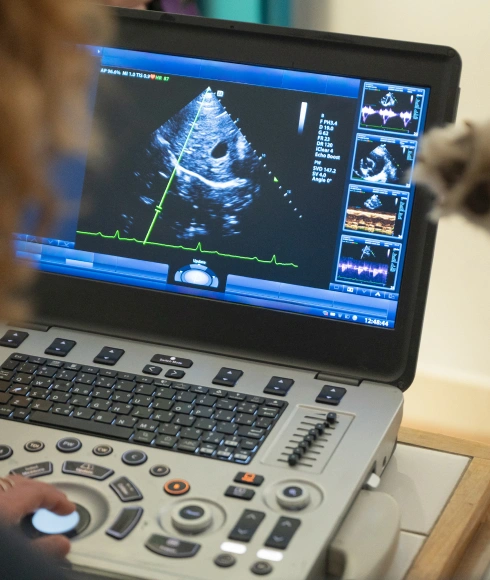
Echocardiogram
When an echocardiogram is performed, it shows an image of the heart in real time. It allows the Veterinarian to evaluate the hearts size, shape, and its functionality. They will be able to measure wall thickness, examine heart valves, and assess blood flow. As with other ultrasounds, echocardiograms are painless, non-invasive, and offer high resolution imaging.
What You Can Expect:
- In-Clinic low-stress procedure.
- Your pet will stay with our veterinary care team for the day.
- Your pet will be monitored by our highly qualified veterinary technicians, for comfort and stability from drop off to pick up.
- Ultrasound is performed by our Certified Sonographer RVT.
- All cases are reviewed by Board Certified Specialist.
- As part of a Comprehensive Echocardiogram, a blood pressure and ECG will also be performed.
Is Anesthesia Required for an Ultrasound?
While Anesthesia is not required, light oral or injectable sedation may be used when performing the procedure to ensure optimal images and patient comfort.
Do I Need to Have My Pet Shaved?
Yes, we shave the fur so that we can obtain clear, sharp images. Ultrasound waves can’t pass through air, so the probe must make full contact with the skin.
Allergies & Dermatology
Caring for your pet’s skin is essential, and when they have skin-related issues, it can range from uncomfortable for your pet to dangerous. That’s why we emphasize allergy and dermatology as essential parts of a holistic veterinary service offering.
Dermatitis can be caused by allergic reactions, skin cancer, hormonal disorders, autoimmune disease, tumors, infections, and other factors. If you’re worried that your pet may be suffering from a dermatological condition, look for the following warning signs:
- Flaky or red skin
- Hair loss
- Excessive licking or biting
- Excessive itching
- Watery or irritated eyes
- Lumps or bumps on the skin
- Unseasonable shedding
- Vomiting
- Diarrhea
- Changes in behavior
Endoscopy
Endoscopy is a minimally invasive procedure that makes use of a long and flexible tube with an attached camera, inserted into the stomach or colon of your pet while they’re sedated in order to view the inner workings of your pet’s stomach, esophagus, small intestine, and/or colon. Usually, endoscopies are used to look for and identify abnormalities, swelling, scarring, or other issues.
If after an initial exam we determine that an endoscopy may be necessary to get a closer look, we’ll always discuss this with you before proceeding.